
Clothing Collections
This collection is a harmonious blend of timeless sophistication and modern versatility, designed to celebrate the strength and grace of the contemporary woman.
Drawing inspiration from the rich textures of velvet, the structured beauty of corsetry, and the fluidity of pleated skirts, each piece tells a story of transformation and empowerment.
The ensembles can be worn together for a show-stopping evening look or mixed and matched for everyday wear, offering endless possibilities for self-expression. With intricate details like satin lacing, crinoline-reinforced hems, and detachable elements, this collection bridges the gap between tradition and innovation, inviting you to embrace both the past and the present in every stitch.
Casanova Collection -made for Venice catwalk
The collection consists of 12 looks for mothers and daughters, as well as for Casanovas. For mothers and daughters, the looks are coordinated in color, fabric texture, and the use of accessories.
The collection features outerwear made of velvet with a lining of Armani silk featuring a romantic print, as well as satin eveningwear: dresses, corsets with skirts, and accessories made of mesh adorned with embroidery featuring beads and butterflies painted in fluorescent colors that come to life under ultraviolet light.
These elements are harmoniously complemented by accessories such as hats, headpieces made of silk flowers and polymer clay, and muff-style handbags.
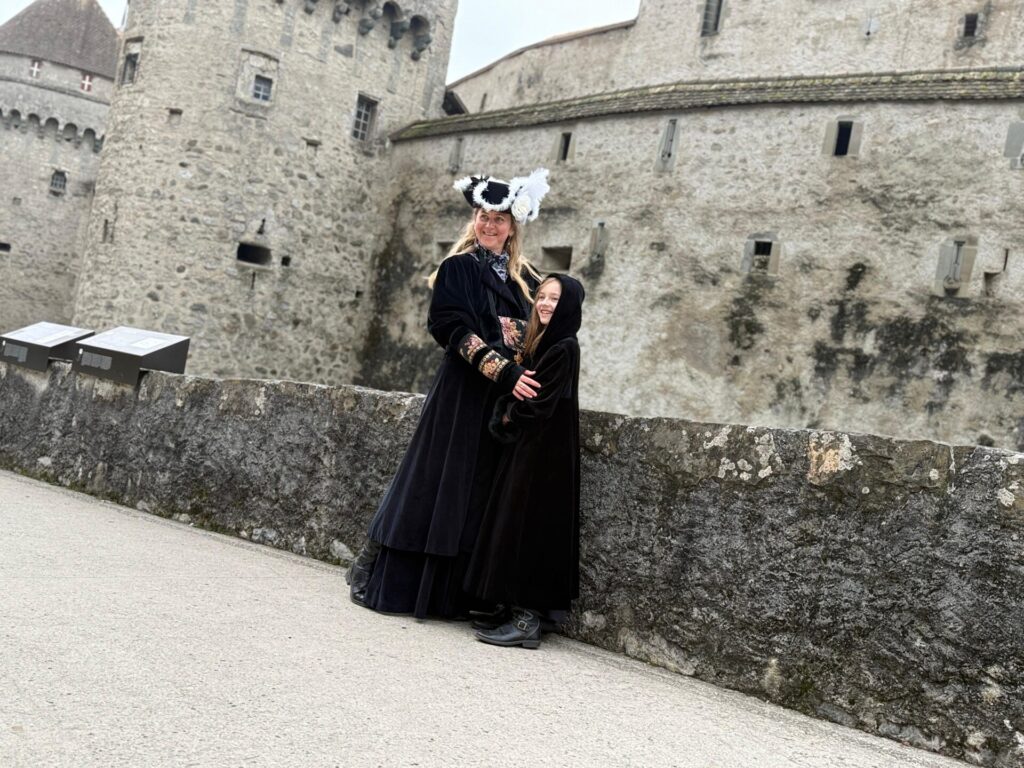
Elspeth and Aveline
Mum and Daughter Co-ordinated outfit
A velvet coat with a detachable hem and hood, transforming into a jacket, paired with a long, elegant velvet skirt on a zipper with a lining. The blouse is made from the same material as the lining, featuring detached sleeves with ruffles.
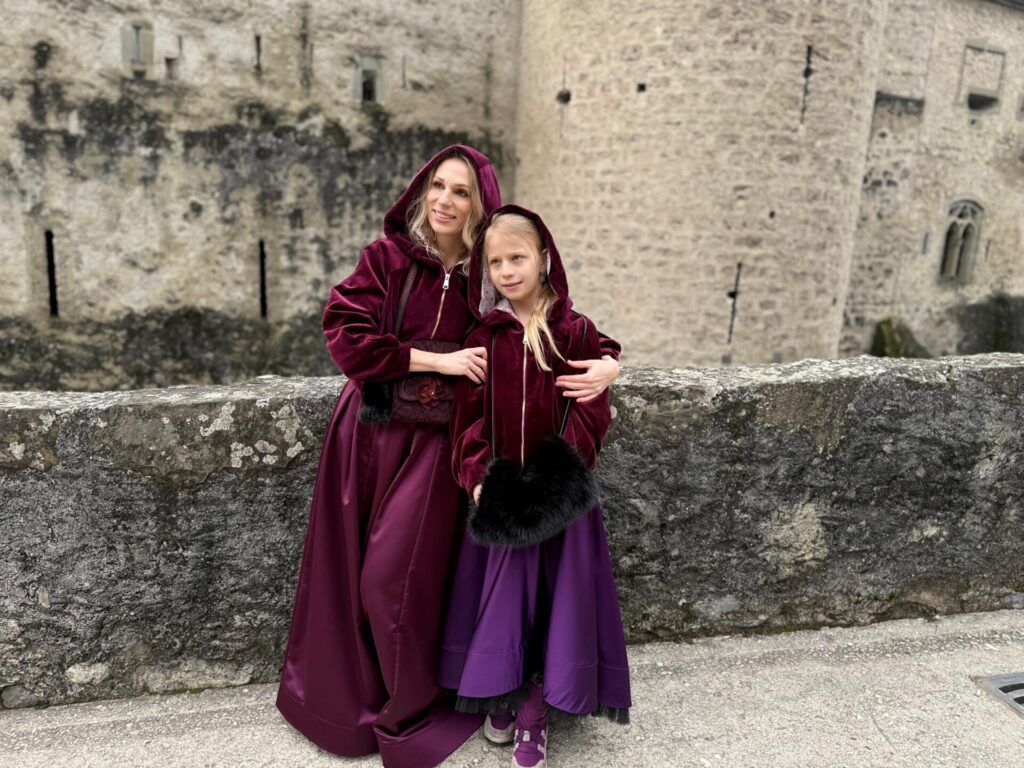
Maeve and Liora
Mum and Daughter Co-ordinated outfit
A velvet bomber jacket with lining, a corset with whalebone support and satin lacing, and a long skirt with beautiful pleats reinforced with crinoline at the hem. The pieces can be worn together as an evening gown or mixed separately—for example, pairing the corset with jeans or the skirt with a sweater for everyday wear.
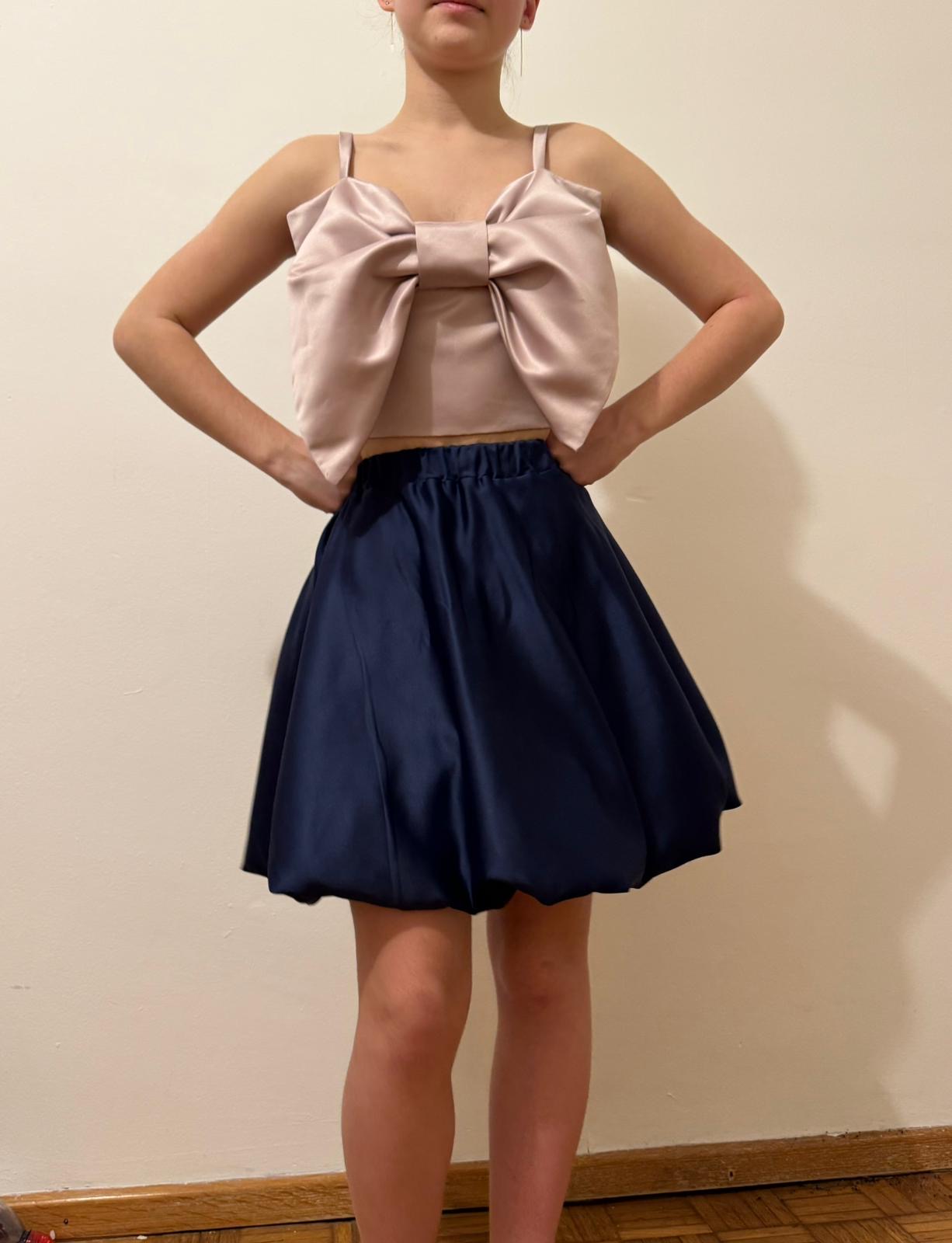
Janette
Girl outfit - part of the set
This charming outfit is a perfect blend of elegance and playful femininity, featuring a harmonious combination of rose and blue satin that complements each other beautifully.
The top is the centerpiece of the look, crafted from soft, shimmering rose satin with a fitted silhouette that accentuates the waist. The standout detail is the oversized bow adorning the front, adding a whimsical and girly touch that exudes fun and confidence. The bow’s voluminous shape and delicate satin texture create a statement-making focal point, while its placement enhances the overall silhouette.
Paired with the top is a flowing blue satin skirt that balances the look with its rich, jewel-toned hue. The skirt’s A-line cut skims the body gracefully, offering movement and a touch of sophistication. The contrast between the rose and blue tones creates a visually striking yet cohesive ensemble, perfect for making a stylish impression.
Story about Elspeth
Ah, let me tell ye the tale o’ this enchanting velvet ensemble, a creation born o’ love, craftsmanship, and a touch o’ magic. ‘Twas said to have been designed in a wee village nestled in the Scottish Highlands, where the mist clung to the hills and the lochs sparkled like liquid silver. The story begins with a young lass named Elspeth, a seamstress wi’ a heart as deep as the velvet she adored.
Elspeth’s hands were gifted, able to weave dreams into fabric. She lived in a cottage by the edge o’ the forest, where she spent her days crafting garments for the villagers. But her heart longed to create somethin’ extraordinary, somethin’ that would capture the essence o’ the land she loved. One evenin’, as the sun dipped below the hills, a traveler arrived at her door—a mysterious man wi’ eyes like the midnight sky and a voice as smooth as the finest silk. He carried wi’ him a bolt o’ the richest velvet, dyed in shades o’ deep sapphire and emerald, and asked Elspeth to create an outfit fit for a queen.
Inspired by his request, Elspeth set to work, pourin’ her soul into every stitch. The coat she designed was no ordinary piece—it was a marvel o’ ingenuity, wi’ a detachable hem and hood that could transform it from a grand, sweeping coat into a sleek jacket. This, she said, was to mirror the changin’ moods o’ the Highlands, where storms could give way to sunshine in the blink o’ an eye. The long, elegant skirt she paired wi’ it was fastened wi’ a hidden zipper, its lining as soft as a lover’s whisper. The blouse, crafted from the same delicate linin’, featured detached sleeves wi’ ruffles that danced like the petals o’ a wild rose in the breeze.
As she worked, the traveler would often visit, his presence stirrin’ somethin’ in Elspeth’s heart. He spoke o’ faraway lands and ancient tales, and she found herself fallin’ for him, stitch by stitch. When the outfit was finally complete, he revealed his true identity—a prince from a distant kingdom, seekin’ a gift for his betrothed. Though her heart ached, Elspeth handed him the garment, knowin’ it would carry a piece o’ her soul forever.
But as the prince prepared to leave, he turned to her and said, “No lass but you could wear such a creation wi’ the grace it deserves.” And wi’ that, he asked her to be his queen. The outfit, they say, became a symbol o’ their love, a blend o’ practicality and romance, much like the Highlands themselves. And to this day, it’s whispered that wearin’ the ensemble brings a touch o’ Elspeth’s magic—a reminder that true beauty lies in the heart, and love can transform even the simplest o’ things into somethin’ extraordinary.
Story about Maeve
Ah, let me introduce ye to Maeve O’Connell, a spirited lass wi’ a heart as bold as her fashion sense. Maeve hails from the bustling streets o’ Dublin, where the cobblestones echo wi’ the laughter o’ storytellers and the hum o’ creativity. She’s a modern-day designer wi’ a deep love for the past, blendin’ the elegance o’ bygone eras wi’ the practicality o’ today. The velvet bomber jacket, corset, and pleated skirt ensemble is her pièce de résistance, a creation born o’ her own journey o’ self-discovery and resilience.
Maeve grew up in a family o’ tailors, her hands learnin’ the art o’ stitchin’ before she could even write her name. Her grandmother, a formidable woman wi’ a penchant for Victorian fashion, taught her the secrets o’ corsetry and the magic o’ structure. But Maeve was a dreamer, always yearnin’ to break free from tradition and create somethin’ entirely her own. One fateful evenin’, while rummagin’ through her grandmother’s attic, she stumbled upon an old trunk filled wi’ vintage fabrics—rich velvets, delicate satins, and yards o’ crinoline. It was as if the trunk whispered to her, urgin’ her to weave a new tale.
The velvet bomber jacket was the first piece she crafted, inspired by her father’s old flight jacket but transformed into somethin’ entirely feminine and fierce. The corset, wi’ its whalebone support and satin lacing, was a nod to her grandmother’s teachings, but Maeve added her own twist—makin’ it sturdy yet comfortable, somethin’ a modern woman could wear wi’ pride. The long pleated skirt, reinforced wi’ crinoline at the hem, was her ode to the romance o’ the past, yet designed to move wi’ the freedom o’ the present.
The story goes that Maeve created this ensemble for herself, as a symbol o’ her own transformation. She’d always felt torn between the old world and the new, between tradition and rebellion. But as she stitched each piece, she realized she didn’t have to choose—she could honor both. The outfit became her armor, a way to face the world wi’ confidence and grace. Soon, others took notice, and Maeve’s designs became sought after by women who wanted to feel powerful and beautiful, whether they were attendin’ a grand ball or strollin’ through the city streets.
Maeve’s creations, much like her story, are a testament to the power o’ blendin’ the old wi’ the new. The pieces can be worn together as a show-stoppin’ evening gown, or mixed and matched for everyday wear—pairin’ the corset wi’ jeans for a touch o’ rebellion, or the skirt wi’ a cozy sweater for a dash o’ romance. Each garment carries a piece o’ Maeve’s journey, remindin’ us that true beauty lies in embracin’ all parts o’ ourselves, past and present.
And so, Maeve O’Connell’s name became synonymous wi’ boldness and elegance, her designs a celebration o’ the strength and versatility o’ women everywhere. Her story, like the outfit she created, is a reminder that we can honor where we’ve come from while fearlessly chartin’ our own path.
Glimpses of Creation
This captivating video takes you behind the scenes, revealing the meticulous journey of bringing a fashion vision to life. From the first strokes of a designer’s pencil on paper to the final flourish on the runway, witness the artistry, passion, and precision that transform sketches into stunning garments.
Watch as fabrics are cut, seams are stitched, and details are perfected, culminating in a breathtaking moment on the podium where creativity meets the spotlight. A celebration of craftsmanship and imagination, this is the story of fashion in motion.
Inspired by Travel Collection
This collection is a vibrant tapestry of cultures, inspired by the rich heritage and breathtaking landscapes of Belarus, Uzbekistan, and beyond.
From the earthy tones and intricate embroidery of Eastern Europe to the bold patterns and luxurious silks of Central Asia, each piece tells a story of exploration and connection.
Flowing silhouettes, handcrafted details, and versatile designs capture the spirit of wanderlust, inviting you to embark on a sartorial journey.
Whether adorned with traditional motifs or reimagined for modern elegance, this collection celebrates the beauty of diversity and the timeless allure of travel.
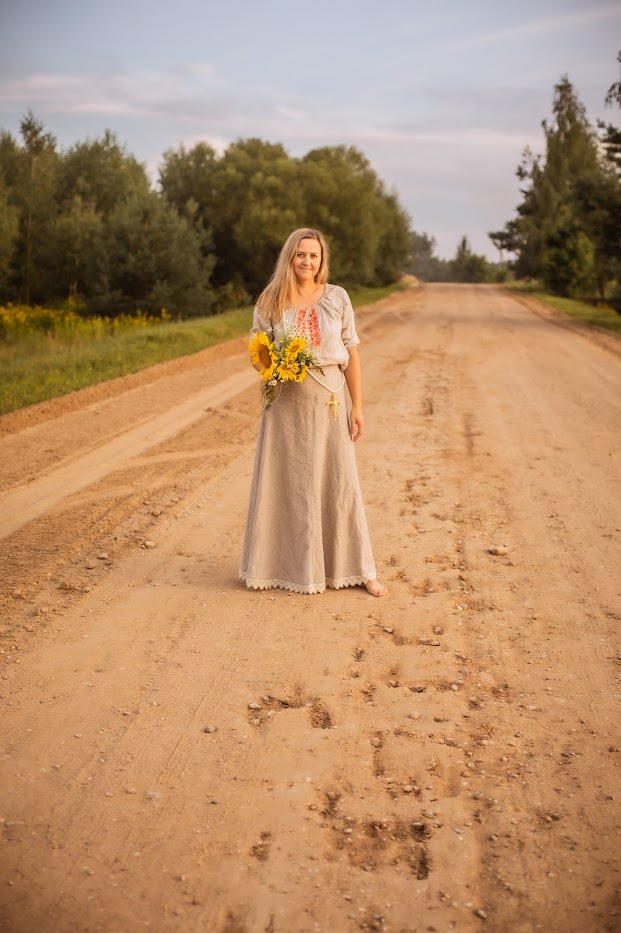
The Keeper of Kupala
Linen with folk embroidery
In this collection, I was inspired by Belarusian folklore—deeply rooted in the country’s history, nature, and Slavic traditions.
It embodies the beliefs, customs, and way of life of the Belarusian people, passed down through generations in fairy tales, myths, songs, rituals, and traditional clothing.
A special source of inspiration was the traditional summer festival Ivan Kupala. During this vibrant midsummer celebration, known for fire-jumping and flower-wreath floating, I encountered artisans crafting beautiful pieces from straw, linen, wood, and ceramics. Their craftsmanship and connection to heritage deeply moved me.
Belarusian folklore has endured for centuries, shaping literature, music, and modern cultural identity. Through this collection, I aim to carry these traditions forward and give them new life.
Here, you will find exquisite headpieces woven from straw, embroidered linen earrings adorned with Slavic symbols, ceramic rings, flowing linen skirts and blouses, and handcrafted decorations made from flowers, jute, and wood—each piece a tribute to the rich artistry and spirit of Belarusian folklore.
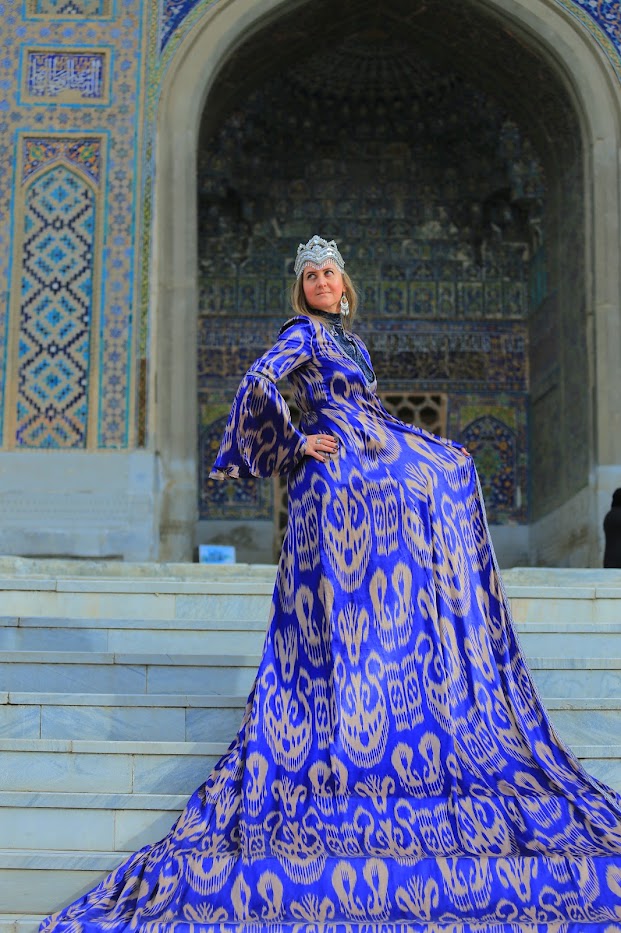
The Princess of the Blue Silk
silk
Uzbekistan’s silk tradition is a centuries-old art form, deeply rooted in the heart of Central Asia. The country is renowned for its ikat silk, a meticulous dyeing and weaving technique where threads are dyed in vibrant, intricate patterns before being woven into luxurious fabrics.
This process, passed down through generations, creates mesmerizing designs that often feature symbolic motifs like pomegranates, blossoms, and geometric shapes, each telling a story of culture, nature, and heritage.
The traditional Uzbek dress, often made from this exquisite silk, is a flowing, ankle-length robe known as a “khan atlas” or “atlas dress.”
It is celebrated for its bold, colorful patterns and lightweight, shimmering fabric that moves gracefully with every step.
The dress is typically paired with wide-legged trousers and a scarf, embodying both elegance and practicality. A symbol of national pride, the atlas dress is worn during celebrations, festivals, and special occasions, showcasing the timeless beauty of Uzbekistan’s craftsmanship and the enduring spirit of its people.
Story about Marina, The Keeper of Kupala
In a small village nestled deep within the Belarusian countryside, where the forests whispered ancient secrets and the rivers sang songs of old, there lived a peasant girl named Marina.
She was known for her radiant smile, her hands stained with the earth she tended, and her heart full of stories passed down from her grandmother. Marina’s village was a place where time seemed to stand still, where traditions were woven into the fabric of daily life, and where the summer festival of **Ivan Kupala** was the most magical time of the year.
Marina’s grandmother, whom everybody called Babushka, was the village’s storyteller, a keeper of folklore and wisdom. She taught Marina the old ways—how to weave wreaths from wildflowers, how to embroider linen with symbols of protection and prosperity, and how to honor the spirits of the forest and water.
Babusya often spoke of the Kupala night, when the boundaries between the earthly and the mystical blurred, and young maidens would float their flower wreaths on the river, hoping to glimpse their future in the flickering candlelight.
One summer, as the Kupala festival approached, Babushka fell ill. The village feared the loss of their beloved storyteller, but Marina refused to let the traditions fade.
She took it upon herself to prepare for the festival, gathering flowers from the meadows, weaving wreaths with her grandmother’s guidance, and stitching intricate patterns into linen garments.
She even ventured into the forest to collect straw, which she fashioned into delicate headpieces adorned with wildflowers and herbs.
On the night of Kupala, the village gathered around a roaring bonfire. Marina, dressed in a flowing linen skirt and blouse embroidered with ancient symbols, led the young maidens to the river.
As they floated their wreaths, Marina’s heart swelled with pride and sorrow, knowing her grandmother was too weak to join them. But as the wreaths drifted downstream, something extraordinary happened.
The river seemed to glow, and the air filled with the scent of blooming flowers. The villagers whispered that the spirits of Kupala had blessed them.
The next morning, Babushka’s health began to improve. She smiled at Marina and said, “You have carried the traditions forward, my child. The spirits are pleased.” From that day on, Marina became known as The Keeper of Kupala, a guardian of her village’s heritage.
She continued to weave, embroider, and craft, teaching the younger generations the old ways while infusing them with her own creativity.
Years later, Marina’s creations caught the attention of travelers and artisans from distant lands. Her straw headpieces, embroidered linens, and handcrafted decorations became symbols of Belarusian folklore, celebrated for their beauty and connection to the past.
Yet, Marina remained rooted in her village, her heart forever tied to the forests, rivers, and traditions that had shaped her.
Through her hands, the spirit of Belarusian folklore lived on, a testament to the power of heritage and the magic of Kupala.
And so, Marina’s story became a part of the very folklore she cherished, a tale of a peasant girl who wove the past into the present and kept the soul of her people alive.
Story about Zarina, The Princess of the Blue Silk
In the heart of Uzbekistan, where the sun kissed the golden sands and the minarets of ancient cities pierced the sky, there lived a princess named Zarina.
She was the jewel of the kingdom, known not only for her beauty but for her love of the arts and her deep connection to her heritage.
Zarina’s palace was a marvel of intricate mosaics and towering arches, but it was her chambers that held her greatest treasures—walls lined with shelves of hand-painted ceramics, shelves stacked with richly woven textiles, and a wardrobe filled with garments that told the story of her people.
Zarina’s favorite possession was a silk dress of the deepest blue, a gift from her mother on her sixteenth birthday. The dress was no ordinary garment; it was a masterpiece of craftsmanship, dyed with indigo from the Fergana Valley and printed with delicate patterns inspired by the national motifs of Uzbekistan—pomegranates symbolizing fertility, almond blossoms for hope, and intricate geometric designs representing the harmony of the universe.
The dress flowed like water, its fabric whispering against the marble floors as Zarina moved, and its patterns seemed to come alive in the sunlight, telling stories of her ancestors.
Though Zarina lived a life of luxury, her heart yearned for something more. She spent her days wandering the bustling bazaars of Samarkand, where artisans displayed their wares—ceramics painted with lapis lazuli, carpets woven with threads of gold, and silks that shimmered like the night sky. She would often sit with the weavers and potters, listening to their tales and learning their crafts.
The people adored her, not for her title, but for her kindness and her genuine love for their traditions.
One day, as Zarina strolled through the bazaar, she noticed a young boy struggling to sell his family’s ceramics. His hands were stained with clay, and his eyes were filled with desperation. Zarina approached him and learned that his family’s workshop was on the brink of ruin. Without hesitation, she purchased every piece, promising to display them in the palace and share their story with visiting dignitaries.
The boy’s gratitude brought tears to her eyes, and in that moment, Zarina realized her true calling.
She returned to the palace and donned her blue silk dress, its patterns a reminder of the strength and resilience of her people.
She began to host grand gatherings, not just for nobles, but for artisans and craftsmen from across the kingdom.
She wore her dress proudly, its national patterns a symbol of her commitment to preserving and celebrating Uzbek culture.
Under her patronage, the bazaars flourished, and the traditions of her people were passed down to new generations.
Zarina became known as The Princess of the Blue Silk, a ruler who wore her heritage with pride and used her position to uplift her people. Her dress, once a symbol of her royal status, became a beacon of hope and unity, a reminder that beauty and strength could be found in the threads of tradition.
And so, Zarina’s legacy lived on, woven into the fabric of Uzbekistan’s history. Her blue silk dress, with its printed national patterns, became a symbol of a princess who not only ruled a kingdom but also cherished its soul.